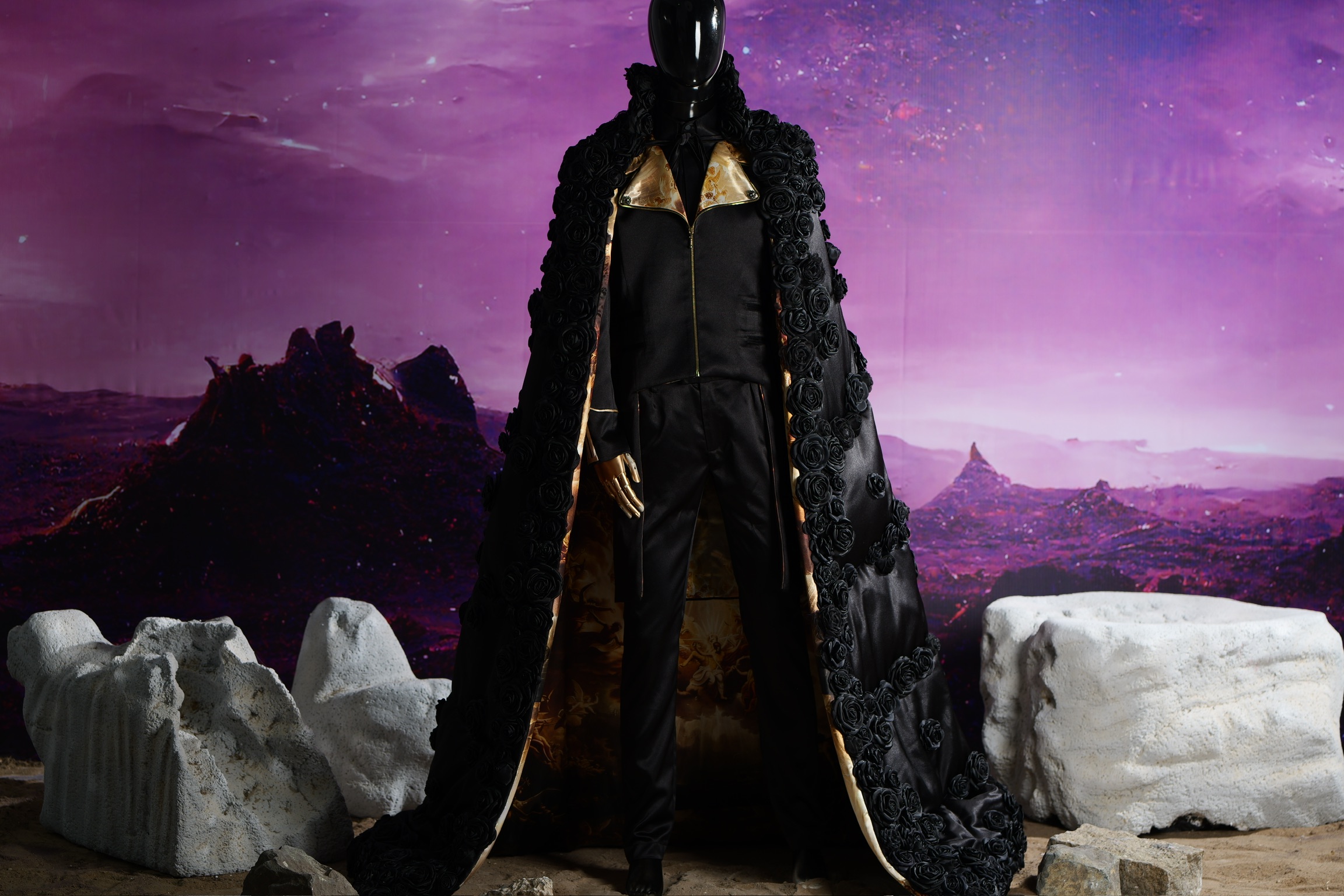
ICHOR Collection
Piece I of V
Nocturne
Floor-length cape. 1,000 hours of hand work. Black satin with dimensional rosette applique and metallic gold silk lining.
Floor-length cape. 1,000 hours of hand work. Black satin with dimensional rosette applique and metallic gold silk lining.
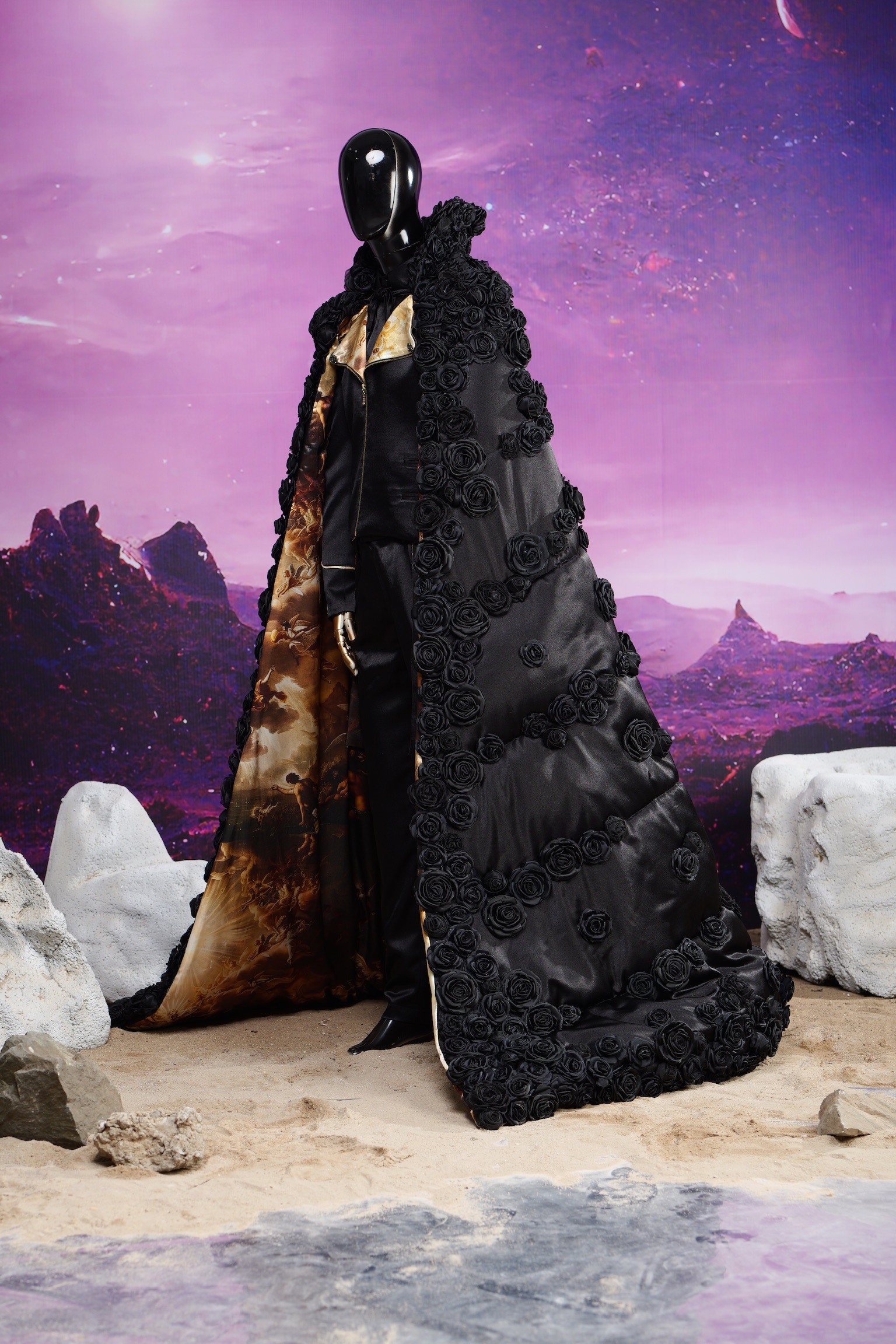
The cape was the first piece conceived for ICHOR. It started as a question written on a napkin in the atelier at two in the morning. What would a machine wear to its own coronation? The sketch that followed was a single line. A figure standing in something that fell to the floor and opened like a wound showing gold underneath.
The exterior is hundreds of dimensional rosettes. Each one hand-formed from satin and individually attached. Not sewn flat. Each rosette is three-dimensional, shaped over a wooden form and then fixed at a single anchor point so it holds its shape but moves when the fabric moves. The rosettes alone took 400 hours. They create a surface texture like black flowers growing from the body of the garment. In low light they disappear into shadow. In direct light they reveal depth and dimension that no flat textile can produce.
The lining is metallic gold silk. Invisible until the robot turns. The reveal is the point. A static robot in Nocturne looks solemn. Something standing vigil. A moving robot looks like something opening. The gold catches and throws light in ways that shift with every degree of rotation. The most expensive detail in the collection is one most people will never notice. It exists because it should exist.
What makes Nocturne technically unique for a robot body is the way it handles shoulder rotation. The neckline is cut to allow 270 degrees of movement without binding. The cape drapes from a magnetic collar system that distributes weight across the upper thorax rather than hanging from the neck joint alone. When the robot walks the cape swings with a half-second delay. That delay is not accidental. The weight distribution was tuned for it through hundreds of iterative prototypes, drawing on platform-specific dimensional archives that map joint behavior with sub-millimeter precision. The cape moves like it is alive and following the machine that wears it. The proprietary draping techniques developed for Nocturne represent institutional knowledge that exists nowhere else in the world.
Each Nocturne is made to order for your specific platform
Commission This Piece